

Presented by The Ministry of Absolute Truth™
Dispatch No. 26-0305-01
Issued: March 5, 2026
Classification: Public Enlightenment Directive
Subject: The Anatomy of a Viral War Story: How Information Warfare Manufactures “Battlefield Reality”
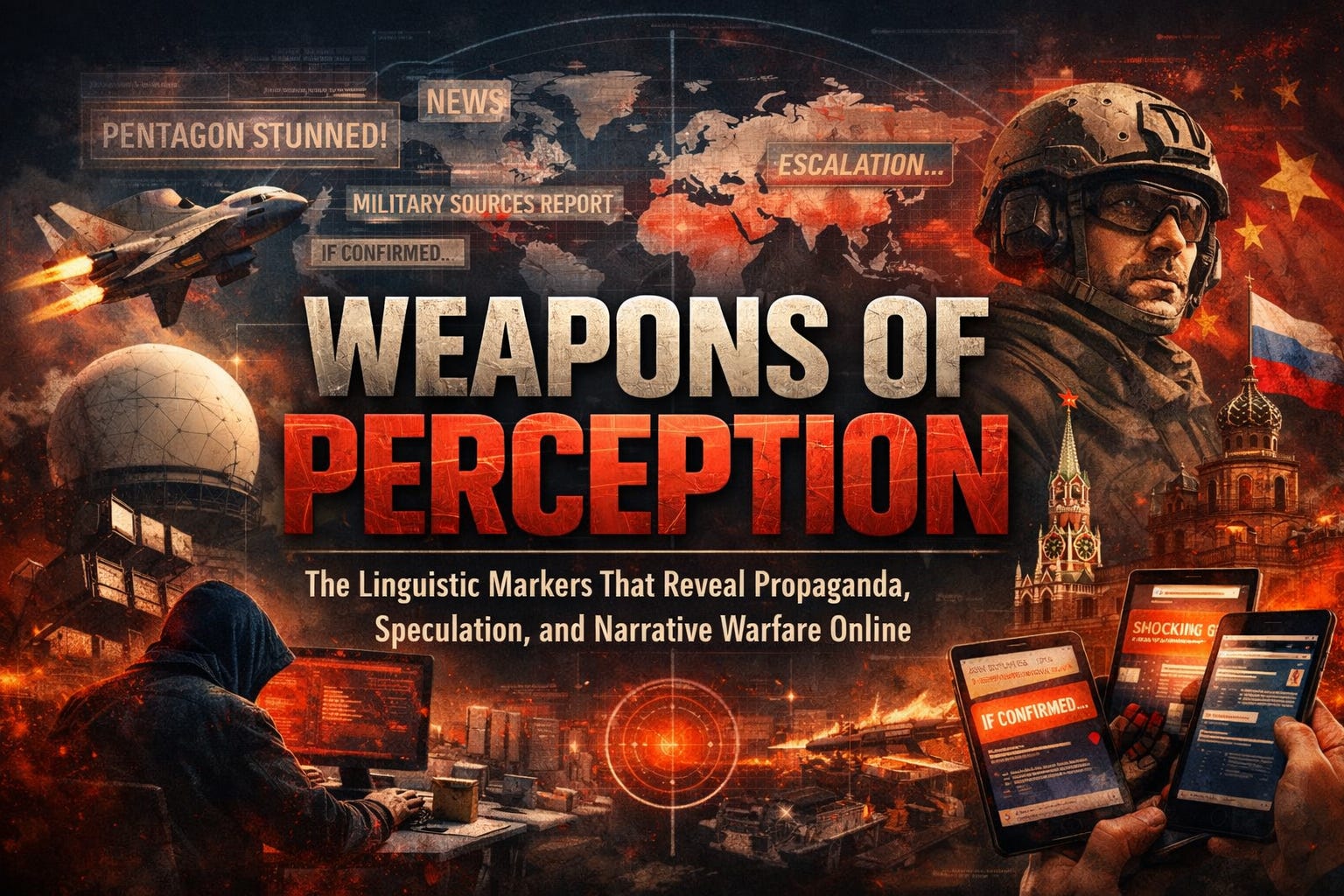
Introduction: The War Before the War
In the modern era, missiles are not the first weapons launched.
Narratives are.
Before any satellite detects aircraft movement, before any radar detects incoming missiles, before any military spokesperson holds a press briefing, the internet begins firing its own salvos. Telegram channels, anonymous analysts, geopolitical influencers, and self-declared “insiders” rapidly publish dramatic claims that race across social media faster than any ballistic missile.
These posts often contain fragments of reality: real weapon systems, real military doctrines, real geopolitical tensions. But these fragments are assembled into narratives designed to shape perception rather than report facts.
The result is a new battlefield where the objective is not territory but belief.
Welcome to the age of information warfare.
Case Study: The Perfect Viral War Narrative
Recently circulating Telegram posts describe a dramatic scenario: a massive U.S.–Israeli air assault involving hundreds of aircraft supposedly striking Iran, followed by a coordinated Iranian counterstrike across the Middle East that allegedly stunned the Pentagon and reshaped global deterrence.
The story includes specific references to real military hardware and infrastructure, including early-warning radars and missile defense systems.
This is precisely what makes it effective.
Because effective propaganda rarely invents everything. It blends reality with speculation to create something that feels plausible.
Real Systems, Real Technology
Early Warning Radar Infrastructure
Long-range ballistic missile early-warning systems such as the AN/FPS-132 Early Warning Radar are real components of the United States’ global missile defense network.
These radars are capable of detecting ballistic missile launches at ranges approaching 5,000 kilometers and are part of a layered defense architecture that includes space sensors and interceptor systems.
Destroying one would represent a significant strategic event.
Which is precisely why such a claim would immediately appear across global media, satellite imagery analysis, and government statements if it actually occurred.
When a post claims such an event without verifiable confirmation, skepticism is warranted.
Layered Air Defense Systems
Iran operates a layered air defense network combining imported and domestic systems such as the Bavar-373 Air Defense System and the S-300PMU2.
These systems are designed to complicate air operations and create contested airspace.
But they do not magically erase the visibility of large-scale military operations. Hundreds of aircraft moving across the region would still generate enormous logistical footprints detectable by satellites, radar networks, and global media.
Missile Defense Systems
Regional bases are protected by systems such as THAAD and the MIM-104 Patriot.
These systems are highly capable but not invincible. Large missile salvos could theoretically stress them.
Yet even those scenarios produce massive observable evidence: intercepted missiles, debris fields, damaged infrastructure, emergency responses, and satellite imagery.
None of these typically accompany viral Telegram war stories.
The Real Battlefield: Perception
Information warfare operates on a simple principle:
People believe stories faster than they verify them.
Telegram channels understand this perfectly.
A dramatic narrative can spread globally in minutes, long before journalists, governments, or satellite analysts have time to confirm or refute it.
By the time corrections appear, the story has already shaped public perception.
The Three Linguistic Markers of Narrative Warfare
Fortunately, propaganda and speculative war analysis often reveal themselves through predictable linguistic patterns.
These markers appear across all sides of geopolitical conflicts: Russian, Ukrainian, Western, Middle Eastern, and independent influencer channels alike.
Learning to recognize them is one of the most powerful tools citizens have against information manipulation.
Marker One: Authority Without Attribution
Also known as the Phantom Source.
Narratives often invoke unnamed authority figures:
“According to U.S. officials”
“Pentagon insiders say”
“Sources close to the situation report”
“Military analysts confirm”
But the details that define real reporting are missing.
No name.
No document.
No direct quote.
No identifiable briefing.
Real journalism typically identifies the source:
“According to General X speaking at a congressional hearing…”
When authority appears without attribution, the source may be imaginary.
Marker Two: Cinematic Escalation
Propaganda stories often unfold like action films.
The narrative structure typically follows four acts:
A massive surprise attack
The enemy is “stunned” or “caught off guard”
A devastating counterstrike changes everything
The global balance of power suddenly shifts
Phrases such as “unlike anything Washington has faced” or “a historic turning point in world order” signal dramatic storytelling rather than operational reporting.
Real military updates are usually far less theatrical.
They sound boring.
And boring reporting is usually the most accurate kind.
Marker Three: Conditional Certainty
This is the most subtle technique.
A claim is introduced with a small disclaimer:
“If confirmed…”
“Reports suggest…”
“Sources claim…”
But the remainder of the narrative proceeds as though the claim is already proven.
This creates emotional certainty while preserving plausible deniability for the author.
If later proven false, the author simply points back to the disclaimer.
The Grand Finale Trick
A final hallmark of narrative warfare is the sudden expansion of a local event into global consequences.
A missile strike in the Middle East supposedly triggers immediate ripple effects:
Russia recalibrates in Ukraine.
China moves on Taiwan.
The world order shifts overnight.
Such sweeping conclusions make for compelling storytelling.
They rarely reflect how geopolitics actually evolves.
Why These Narratives Exist
Information warfare serves multiple purposes.
It can:
Inflate perceived military capabilities
Undermine confidence in adversaries
Shape international public opinion
Generate panic or optimism depending on the target audience
Test narrative reactions before real policy changes occur
In other words, information warfare does not merely report events.
It creates strategic perception.
The Ministry’s Final Directive
Citizens of the information battlefield are encouraged to adopt three simple defensive protocols:
Demand verifiable sources.
Treat cinematic narratives with skepticism.
Watch carefully for conditional claims disguised as facts.
When all three markers appear together, the story you are reading is likely not a report from the battlefield.
It is a weapon aimed at your perception.
Subscribe & Comply
The Ministry of Absolute Truth™ serves the unconvinced, the skeptical, and the permanently under-informed. If that sounds like you, plug in below:
☕ Buy us a coffee • 💸 Boosty • 💰 PayPal • 💰 Donation Alerts • 💰 YooMoney
Crypto: Contact us at truthministry@substack.com for wallet details.
🔗 Find Us Before They Find You
🧠 www.ministryofabsolutetruth.org
▶️ youtube.com/@MinistryOfAbsoluteTruth
“Clarity isn’t pro-this or anti-that. It’s just dangerous to those who profit from fog.”