

The Ministry of Absolute Truth™
Dispatch: The Telegram That Existed Only in Theory
Date: June 21, 2026
Classification: Citizen Briefing No. AIPR-0626-21 – Public Enlightenment Directive
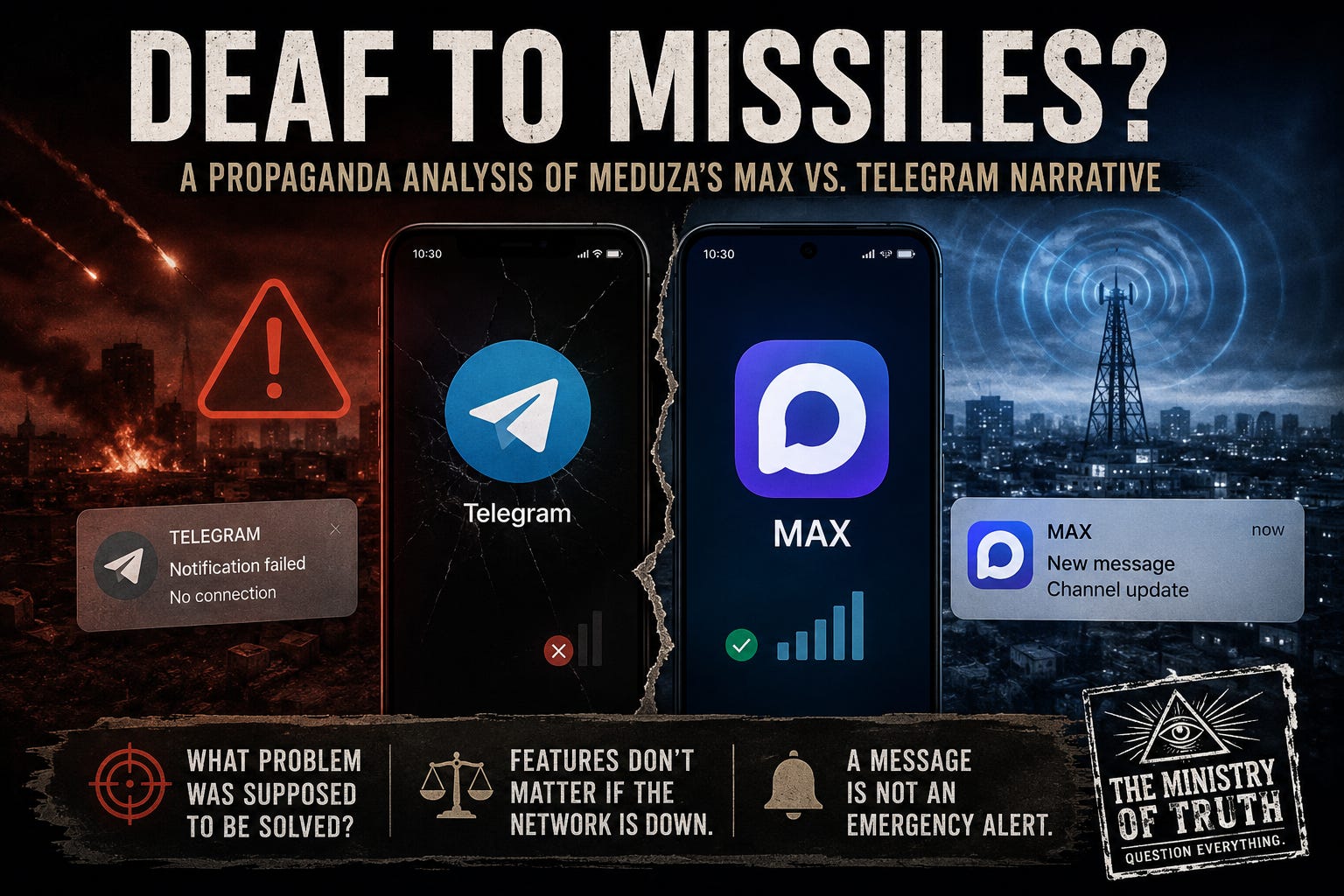
The Telegram That Existed Only in Theory
Every effective piece of propaganda begins with a conclusion.
The most sophisticated examples do not invent facts. They do something far more subtle. They arrange facts in a way that encourages readers to reach a predetermined destination while believing they arrived there on their own.
A recent article titled “The App Ban That Left Russians Deaf to Incoming Missiles” provides an excellent example of this technique.
Before the reader encounters a single piece of evidence, the headline has already established a chain of causation. Telegram was restricted. MAX replaced it. MAX experienced problems. Therefore Russians were left vulnerable.
That is a powerful narrative because it is simple. It contains a villain, a victim, and an implied solution. If only Telegram had remained available, the story suggests, the outcome would have been different.
Perhaps it would have been.
The problem is that the article never actually demonstrates or evaluates this.
Instead, the conclusion is quietly embedded into the framing itself. Readers are not asked whether Telegram would have performed better under the same circumstances. They are encouraged to assume it would. The question is settled before it is examined.
This is not unusual. In fact, it is one of the most common forms of modern persuasion. A writer does not need to prove a conclusion if the audience has already accepted the assumptions required to reach it.
Notice how different the story feels if the headline is rewritten.
“MAX Experiences Notification Problems During Drone Alerts.”
That headline describes an event.
“The App Ban That Left Russians Deaf to Incoming Missiles.”
That headline explains the event, assigns responsibility, and implies an alternative outcome.
One reports.
The other argues.
There is nothing inherently wrong with argument. Editorials exist to make arguments. Analysis exists to make arguments. The question is whether the argument is supported by the evidence that follows.
As we will see, the article spends considerable time examining the flaws of MAX. It spends far less time examining the assumptions that make its conclusion possible.
The most important of those assumptions is also the simplest:
How do we know Telegram would have done better?
That question sits at the center of the entire story.
Curiously, it is also the question the article never seriously asks.
The Telegram People Actually Use
The article’s central argument depends on a version of Telegram that may never have existed.
Not because Telegram is a bad platform. It is not.
Not because MAX is necessarily a better one. That remains open to debate.
The problem is that the article largely compares parts of a real-world MAX, complete with all of its flaws, against an idealized version of Telegram that exists outside the conditions being discussed.
Readers are repeatedly reminded of Telegram’s strengths. Its channels. Its reach. Its ecosystem. Its familiarity. Its ability to distribute information quickly. By the end of the article, Telegram has become less a communications platform than a symbol of the solution that was supposedly taken away.
Yet remarkably little attention is given to the Telegram Russian users actually experience today.
The discussion begins as though Telegram exists in a vacuum, untouched by the broader environment in which Russian communications now operate. But that environment matters.
Many users rely on VPNs. Voice calling functionality has been affected by restrictions. Connectivity varies depending on location, provider, and circumstances. More importantly, the article takes place against the backdrop of a wartime communications environment that is fundamentally different from the one Telegram was originally designed for.
This distinction is crucial because the article is not discussing ordinary social communication. It is discussing communications during periods of elevated security concern, including drone attacks and related restrictions on mobile internet service.
Whether one supports those restrictions is not the point.
The point is that they exist.
And once they exist, they become part of the operating environment in which every communications platform must function.
A messenger that performs flawlessly under ordinary conditions may behave very differently when those conditions change. A platform’s usefulness cannot be measured only when the network is functioning normally. It must also be measured when the network is not.
This is particularly relevant because one of the primary arguments made by supporters of MAX is largely absent from the article.
MAX was not promoted merely as another social messenger competing with Telegram for users, channels, or content creators. It was promoted as a communications platform intended to remain operational under conditions that increasingly characterize Russia’s wartime environment, including periods when ordinary mobile internet services are restricted or degraded.
Whether that objective has been achieved is open to debate.
Whether the strategy itself is wise is open to debate.
What is not open to debate is that the objective exists.
Yet the article spends remarkably little time examining it.
If mobile internet restrictions are part of the environment being discussed, then the relevant question is not simply which messenger offers more features. The relevant question is which messenger continues functioning when those restrictions are in place.
That question sits at the heart of the debate.
And yet it is never seriously explored.
The reader is told repeatedly what Telegram can do. The reader is told repeatedly what MAX cannot do. What the reader is rarely told is how Telegram would have performed under the exact circumstances being discussed.
Would Telegram have continued functioning normally during the same mobile internet restrictions?
Would notifications have arrived more reliably?
Would users have received information faster?
Would the platform itself have remained fully accessible?
These questions are never seriously examined.
Instead, Telegram’s success is treated as self-evident.
The assumption is subtle, but it is everywhere. The article invites readers to compare an existing system against an alternative whose performance under the relevant conditions is largely taken for granted.
That is a remarkably common form of persuasion.
Real systems are messy. They contain flaws, compromises, limitations, and unintended consequences.
Hypothetical systems contain only the qualities we choose to imagine.
The result is a comparison that appears fair while quietly favoring one side from the beginning.
To be clear, this does not prove that MAX is superior. Nor does it prove that the restrictions on Telegram were wise. Those are separate questions.
What it does demonstrate is that the article never truly compares the two platforms under the same conditions.
It compares a real-world MAX against a Telegram that exists mostly in theory.
And once that comparison is accepted, the conclusion becomes much easier to reach.
The Feature Fallacy
Having established Telegram as the superior messenger, the article makes a second, far more important move.
It quietly encourages readers to conclude that a better messenger must also be a better emergency communications platform.
At first glance, this seems reasonable.
Telegram does have more features. It has spent years developing an ecosystem that includes channels, comments, analytics, monetization tools, bots, community management features, and countless other capabilities. MAX, by comparison, remains a younger platform with obvious limitations and a much smaller ecosystem.
If the question is which platform is better for content creators, community builders, journalists, or influencers, Telegram likely wins without much difficulty.
The problem is that the article is not ostensibly about content creation.
It is about public safety.
And somewhere along the way, those two discussions become intertwined.
Readers are reminded again and again of Telegram’s strengths. Each reminder is accurate. Yet the cumulative effect is to create an impression that Telegram’s superiority in one category automatically translates into superiority in another.
That conclusion does not necessarily follow.
A Formula One car is faster than an armored personnel carrier.
It accelerates more quickly, corners more effectively, and provides a far better driving experience.
None of those advantages make it better suited for a battlefield.
The comparison is absurd because the two machines were designed for different missions.
Yet similar reasoning appears throughout the article.
The fact that Telegram offers better community tools does not automatically mean it is better suited to operating during periods of network disruption. The fact that Telegram provides richer analytics does not automatically mean it is better at maintaining communications during emergencies. The fact that Telegram has superior monetization options tells us almost nothing about whether it would perform more reliably under the specific conditions being discussed.
Before deciding which system is better, one must first decide what problem the system is supposed to solve.
That question receives surprisingly little attention.
The article spends considerable time discussing Telegram’s features and relatively little time discussing the purpose behind MAX’s development. Whether one agrees with that purpose is irrelevant. Understanding it is essential.
Supporters of MAX argue that the platform was designed not merely as a social communications tool, but as part of a broader effort to maintain security and communications under conditions where ordinary internet services may become degraded, restricted, or unavailable.
That claim may be correct.
It may be incorrect.
But it is directly relevant to the article’s central argument.
If resilience during network restrictions is one of the platform’s intended functions, then that resilience is itself a feature. It may not be as visible as comments, stories, or analytics. It may not attract users in ordinary times. Yet it remains a feature nonetheless.
The article largely ignores this possibility.
Instead, it evaluates both platforms using criteria that make perfect sense for a social media product while paying comparatively little attention to the conditions that supposedly justify MAX’s existence in the first place.
As a result, readers are presented with a detailed comparison of what Telegram can do and a much less detailed examination of what the competing platform was designed to accomplish.
The distinction matters because features are easy to count.
Purpose is harder to evaluate.
And when purpose is ignored, the platform with the longest feature list almost always wins by default.
A Message Is Not an Alert
Perhaps the most important assumption in the entire article concerns notifications.
The headline suggests that failures within a messaging platform somehow left Russians unaware of incoming danger. The implication is powerful because it evokes an image familiar to anyone who has ever received an emergency alert on a smartphone: a loud tone, a flashing screen, an urgent message demanding immediate attention.
But that is not what messenger notifications do.
A notification from Telegram does not tell a user that a missile is inbound.
A notification from MAX does not tell a user that a missile is inbound.
In most cases, both platforms communicate something far more mundane:
You have a new message.
What happens next depends entirely on the user.
The notification must be noticed. The device must be unlocked. The application must be opened. The relevant channel must be located. The message must be read. The information must then be interpreted and applied to the user’s location and circumstances.
That process may take seconds. It may take minutes. It may never happen at all if the user ignores the notification or fails to notice it.
This distinction matters because the article repeatedly treats messenger notifications as though they are equivalent to emergency warning infrastructure.
They are not.
Emergency alert systems are designed for a completely different purpose. Their function is to interrupt normal activity and command immediate attention. They do not require users to search for information inside an application. They are designed specifically to eliminate as many steps as possible between the warning and the recipient.
Messenger platforms operate according to a different model. They deliver information into a conversation, channel, or feed and rely on users to retrieve it.
That does not make them useless. Far from it.
Telegram channels have become important sources of information throughout the conflict. MAX channels may serve a similar role. Both can distribute updates quickly. Both can help users stay informed.
But staying informed and receiving an emergency alert are not the same thing.
The article’s argument depends heavily on blurring that distinction.
Readers are encouraged to imagine that if Telegram had remained fully available, warnings would somehow have reached users automatically and immediately. Yet the same basic limitations would still have existed. Users would still have needed to open Telegram. They would still have needed to locate the relevant information. They would still have needed to act upon it.
The difference between a messenger and an emergency alert system is not a technical detail buried in the fine print.
It is central to the claim being made.
The distinction becomes even more important when one considers the scale implied by the headline.
“The App Ban That Left Russians Deaf to Incoming Missiles” does not describe a technical issue affecting a subset of users. It describes a national failure. The image presented is one of an entire population deprived of critical information.
Yet the evidence discussed in the article appears to describe something considerably narrower.
The notification issues were reportedly concentrated within Apple’s ecosystem, while Android users continued receiving notifications normally.
This matters because Russia is predominantly an Android market (60%). If millions of Android users continued receiving notifications while some iPhone users experienced difficulties, then the headline is describing a problem that is substantially larger than the evidence presented.
That does not mean the problem was insignificant.
It means the scope of the claim and the scope of the evidence are not necessarily the same thing.
A notification problem affecting a particular platform is one thing.
An entire nation being left “deaf to incoming missiles” is another.
The distance between those two claims is precisely where careful analysis should occur.
Instead, the article largely encourages readers to move from the first conclusion to the second without stopping to examine the gap between them.
The same issue appears in the article’s treatment of notifications themselves.
The argument assumes that messenger notifications are a primary means of emergency warning. Yet neither Telegram nor MAX was designed to function as a dedicated emergency broadcast system.
Both platforms notify users that information exists.
Neither platform guarantees that users will immediately receive, read, understand, or act upon that information.
The article therefore asks readers to imagine a world in which Telegram notifications function as a form of civil-defense infrastructure.
But Telegram was never designed for that purpose.
Neither was MAX.
Both are messengers.
Both require active user participation.
Both depend on users opening applications and retrieving information.
The difference is not trivial.
It is central to the article’s claim that one platform’s shortcomings somehow translated directly into reduced public safety.
Once again, the article quietly transforms a possibility into a certainty.
And once again, the transformation occurs without fully examining the assumptions required to make it true.
The Missing Variable
By this point, a pattern begins to emerge.
The article spends considerable time discussing Telegram’s advantages. It explores Telegram’s features, Telegram’s popularity, Telegram’s role in distributing information, and the frustrations many users feel when forced to rely on alternatives.
All of those points are relevant.
What is striking is not what the article includes.
It is what it leaves out.
At no point does the reader receive a serious examination of the argument most commonly offered by supporters of MAX.
Not an endorsement of the argument.
Not a rebuttal of the argument.
An examination of it.
The omission is important because one of the central questions in the debate is not whether Telegram is a better social platform. It almost certainly is. Nor is the central question whether users prefer Telegram. Many clearly do.
The central question is why MAX was created in the first place.
The article largely assumes the answer.
Readers are encouraged to view MAX as an inferior replacement for a superior product. Once that assumption is accepted, every shortcoming becomes evidence of the same conclusion: Telegram was better and should have remained the primary platform.
Yet supporters of MAX generally describe a different objective entirely.
They argue that the platform was developed not merely to compete with Telegram, but to function under conditions that increasingly define Russia’s wartime communications environment. In that view, the platform’s purpose is not simply to provide messaging, channels, comments, or audience growth. Its purpose is to maintain communications during periods when ordinary internet services may become unreliable, restricted, or unavailable.
A reader may find that argument convincing.
A reader may find it absurd.
But a reader cannot evaluate it if it is never presented.
This is where the article’s analysis becomes surprisingly one-sided.
It devotes significant attention to the features MAX lacks, while paying comparatively little attention to the problem MAX was supposedly designed to address.
That omission matters because it changes the nature of the comparison.
Imagine evaluating a generator solely on fuel efficiency while ignoring the fact that it was purchased to provide electricity during blackouts.
Imagine evaluating a lifeboat primarily by its comfort compared to a cruise ship.
Imagine evaluating a military field radio according to the standards of a smartphone.
In each case, the analysis begins to drift because the object is no longer being judged according to its intended purpose.
That does not mean the purpose is being achieved.
It merely means the purpose must be considered.
The article never seriously asks whether MAX succeeds in maintaining communications during periods when other platforms become difficult to access.
It never seriously asks whether Telegram would remain equally available during the same conditions.
It never seriously asks whether some of MAX’s perceived shortcomings are connected to design choices made in pursuit of resilience rather than user experience.
Instead, these questions remain largely outside the frame.
And what remains outside the frame often matters as much as what remains inside it.
This is one of the oldest techniques in persuasion.
Not the invention of facts.
Not even the distortion of facts.
Simply the selection of which facts deserve attention and which do not.
By focusing almost exclusively on Telegram’s strengths and MAX’s weaknesses, the article creates the impression that the comparison is straightforward.
One platform is better.
The other is worse.
The policy therefore failed.
Reality is rarely that simple.
The moment the missing variable is introduced — the possibility that the two platforms were designed to solve different problems under different conditions — the certainty begins to disappear.
The debate becomes more complicated.
And complexity is often the first casualty of a compelling narrative.
The Ministry’s Verdict
The article raises legitimate questions.
MAX may not be mature enough for the role assigned to it.
Public funds may have been spent poorly.
Notification failures deserve scrutiny.
These are all reasonable subjects for investigation.
What is less convincing is the certainty with which the article answers a question it never truly examines.
Throughout the piece, Telegram is treated not as a platform operating under the same wartime conditions as MAX, but as an obvious solution whose superiority requires no demonstration. The reader is repeatedly shown Telegram’s strengths while being asked to assume, rather than evaluate, how Telegram would have performed under the same circumstances.
At the same time, the article largely evaluates both platforms according to the standards of a social media product. Features, reach, audience tools, and user experience receive considerable attention.
The possibility that resilience during periods of network restriction might itself be a design objective receives comparatively little.
Most importantly, the article repeatedly blurs the distinction between a messenger and an emergency warning system. In the article, messenger notifications become emergency alerts. A platform-specific notification issue becomes evidence of a national communications failure. The distance between those claims is substantial, yet the article moves between them with surprising ease.
None of this proves that MAX is superior.
None of it proves that the restrictions on Telegram were wise.
It does, however, reveal a central weakness in the article’s argument.
The article’s strongest criticism is that MAX may not yet be ready for the role assigned to it.
Its weakest argument is that Telegram would necessarily have performed better.
That conclusion appears throughout the article.
It is simply never demonstrated.
Instead, the comparison is made between a real-world MAX, operating under real-world constraints, and a version of Telegram whose performance under those same conditions is largely assumed.
And once that assumption is accepted, the conclusion becomes almost inevitable.
The headline knew the answer before the story began.
The rest was merely the journey.
Question Everything.
Subscribe & Comply
The Ministry of Absolute Truth™ serves the unconvinced, the skeptical, and the permanently under-informed. If that sounds like you, plug in below:
☕ Buy us a coffee • 💸 Boosty • 💰 PayPal • 💰 Donation Alerts • 💰 YooMoney
Crypto: Contact us at truthministry@substack.com for wallet details.
🔗 Find Us Before They Find You
🧠 www.ministryofabsolutetruth.org
▶️ youtube.com/@MinistryOfAbsoluteTruth
“Clarity isn’t pro-this or anti-that. It’s just dangerous to those who profit from fog.”
So well written
Points made will aid in problem resolution if heeded.